


 Author: Vivi Kwok
Head of Corporate Wellbeing, People Solutions – Asia
Think about the last time you had a rough night. The next day probably felt like this:
- Emails took twice as long to write.
- You zoned out in the middle of a conversation.
- That 3 p.m. meeting? A battle to stay awake.
This is why sleep belongs in the workplace wellbeing conversation. It is not about prying into employees’ sleep habits, but about recognizing the fact that when people are tired, their focus, mood and motivation dip – and that affects productivity, decision-making and results.
Lack of sleep doesn’t always show up as someone nodding off. More often, it’s:
- Snappy emails and short tempers.
- Forgetting key details or missing deadlines.
- “Presenteeism” – physically at work, mentally running on empty.
- Extra coffee runs just to get through the afternoon.
Research showed that people in Asia tended to sleep for shorter durations and had lower sleep quality compared with those in Europe and North America (1). Poor sleep can lead to more mistakes, more sick days and lower engagement at work. It is also consistently linked with higher rates of cardiovascular disease, diabetes, depression and obesity – all of which raise long term claims and benefit costs. But the impact emerges much earlier in day to day performance:
- U.S. employees identified as “poor sleepers” (around 7% of the workforce) had more than double the rate of unplanned absenteeism, resulting in an estimated US$44.6 billion in lost productivity each year (2).
- Studies found that chronic sleep restriction reduced focus, memory and emotional control, affecting customer service, leadership quality and team dynamics (3).
- Findings from the Centers for Disease Control and Prevention showed that over one-third of U.S. adults and nearly eight out of ten teens did not get enough sleep, and about a quarter of adults had chronic sleep disorders such as sleep apnea or insomnia. The National Institute of Mental Health reported that more than one in five U.S. adults had a mental health condition, and extensive research has associated mental health closely with sleep (4).
Practical, Non Intrusive Support HR Can Offer
Rather than asking employees how many hours they sleep, try these four approaches:
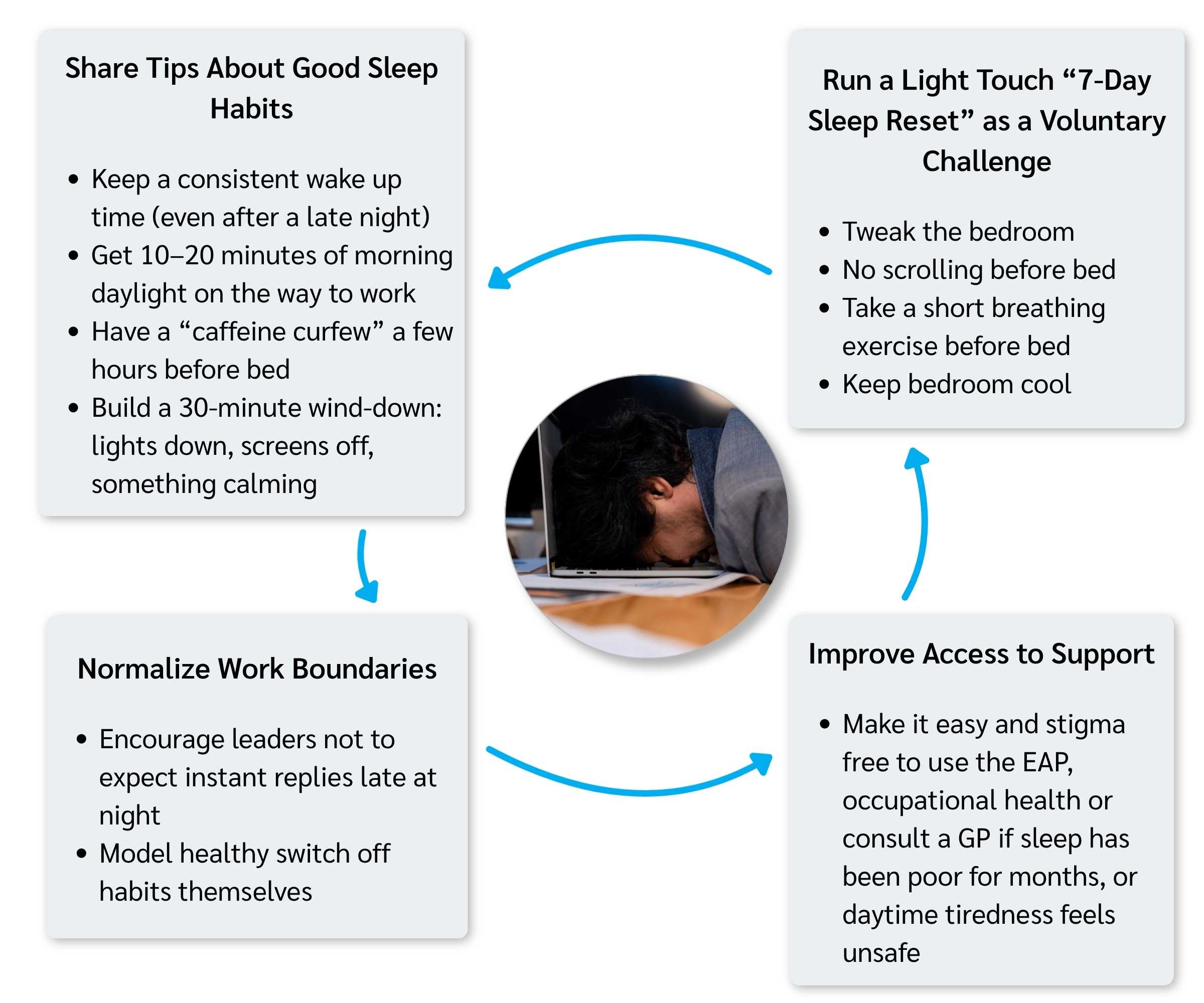
Share tips about good sleep habits:
- Keep a consistent wake up time (even after a late night)
- Get 10–20 minutes of morning daylight on the way to work
- Have a “caffeine curfew” a few hours before bed
- Build a 30 minute wind down: lights down, screens off, something calming
Run a light touch “7 Day Sleep Reset” as a voluntary challenge:
- Tweak the bedroom
- No scrolling before bed
- Take a short breathing exercise before bed
- Keep bedroom cool
Normalize work boundaries:
- Encourage leaders not to expect instant replies late at night
- Model healthy switch off habits themselves
Improve access to support:
- Make it easy and stigma free to use the EAP, occupational health or consult a GP if sleep has been poor for months, or daytime tiredness feels unsafe
The Bottom Line
Sleep isn’t about hitting 8 hours exactly, it’s about getting enough rest with good quality: falling asleep at a reasonable time, staying asleep with minimal awakenings, and waking up feeling refreshed and able to function well during the day.
Sleep is like a hidden performance tool: when people improve it even a little, everything else gets easier – focus, patience, decision making, creativity. HR doesn’t need to become a sleep clinic, but by talking about rest as openly as nutrition and exercise, you can help turn “just getting through the day” into “actually having energy for it.”
As part of LocktonThrive, we are focusing on sleep as a strategic lever to:
- Support daily energy, engagement and performance
- Reduce longer term health risks and claims exposure
- Equip HR and managers to recognize when fatigue may signal deeper concerns
We’ve created 7 Day Individual Sleep Reset Toolkit that helps employees test small, realistic changes – from light exposure and wake times to simple wind down routines and when to seek professional support.
If you’d like to explore how sleep could fit into your wellbeing strategy, please contact us at PeopleSolutions.Asia@lockton.com
Footnote:
(1) Willoughby, A., Alikhani, I., Karsikas, M., Chua, X. Y., & Chee, M. W. L. 10 August 2023. Country Differences in Nocturnal Sleep Variability: Observations from a Large-Scale, Long-Term Sleep Wearable Study. Sleep Medicine, Volume 110. https://www.sciencedirect.com/science/article/pii/S1389945723003003
(2) Gallup. 15 March 2022. Casper-Gallup State of Sleep in America 2022 Report. https://www.gallup.com/analytics/390536/sleep-in-america-2022.aspx
(3) Mohammad A Khan, & Hamdan Al-Jahdali. April 2023. The consequences of sleep deprivation on cognitive. Neurosciences Journal, 28(2). https://pmc.ncbi.nlm.nih.gov/articles/PMC10155483/
(4) Rachel Tompa. 11 August 2025. How sleep affects mental health (and vice versa): What the science says.https://med.stanford.edu/news/insights/2025/08/sleep-mental-health-connection-what-science-says.html